
Travel Captions That Actually Work: Real Strategies Beyond the Obvious Quotes
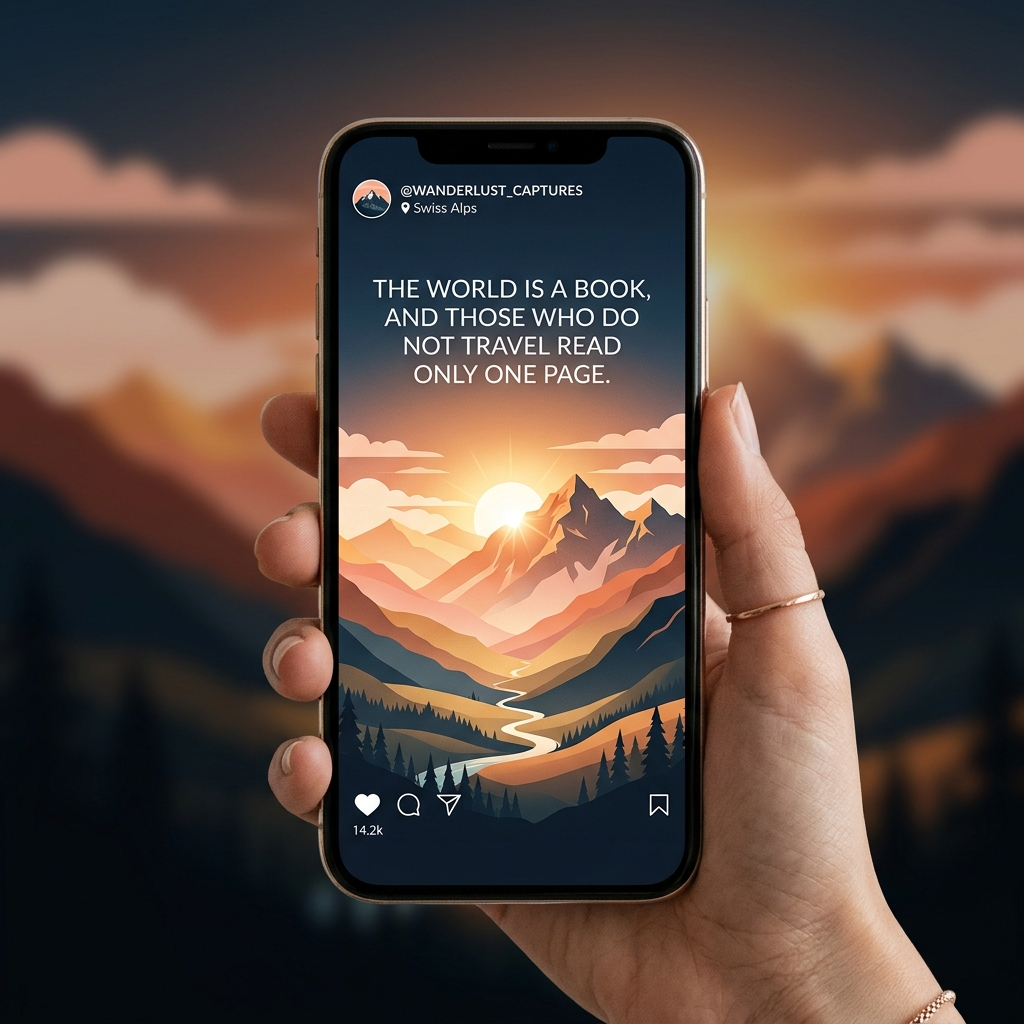
Somewhere right now, someone is posting a sunset photo over the Aegean Sea with the caption "Not all those who wander are lost."
That quote has been used on Instagram so many times that the algorithm probably flags it as low-effort content. The viewer's brain processes it as pure noise — the caption equivalent of elevator music. They double-tap the photo reflexively and scroll on without a second thought about who posted it.
This is the central problem with travel content on Instagram in 2026: the photography has gotten objectively stunning — phone cameras are extraordinary now — but the caption strategy in the travel niche remains almost universally lazy. And caption quality is one of the most overlooked drivers of saves, shares, follows, and that elusive "this is the exact account I've been looking for" feeling.
Here's everything you need to write travel captions that actually do something.
Why Famous Quotes Don't Work (And Why You Keep Seeing Them Anyway)
Famous travel quotes spread because they feel safe. When you're standing in front of a beautiful view and want to honor it with words, borrowing from someone wise feels like the right move. It's not plagiarism — it's tribute.
The problem is that "safe" and "invisible" are the same thing on social media.
When a viewer has seen "The world is a book, and those who do not travel read only one page" forty-seven times this month, their brain categorizes it as a filler caption and stops reading before they reach the end of the sentence. Your photo gets the engagement, not your caption, and you've lost the opportunity to tell someone who you are, what this experience actually meant to you, or why they should follow your account.
What you should use instead of famous quotes: Your own experience, told with specificity.
The more specific the detail, the more universal the resonance. That sounds counterintuitive until you think about why storytelling works: readers don't connect with "beautiful sunset" because it's abstract. They connect with "the ferry back to the mainland left in 20 minutes and I was still barefoot at the top of a cliff trying to figure out if the photo was worth missing the boat." That's a story with stakes and a specific choice. Everyone reading it knows that feeling — even if they've never been to that cliff.
The Six Caption Frameworks That Actually Build Audiences
Instead of reaching for quotes, train yourself to reach for one of these frameworks when you sit down to write a travel caption:
1. The Micro-Story (Most Powerful)
Drop the reader into a specific moment — not a summary of an experience, but the middle of a scene. Present tense works exceptionally well here.
Example:
"It's 5:47 AM and I'm the only person in this piazza. The espresso cart isn't open yet. There's a dog asleep on the church steps. This is the version of Rome the Instagram photos don't capture."
Why it works: The specific details (5:47 AM, dog on church steps) create a mental image that feels real. The final line creates contrast with what the reader expected, which makes them want to follow the creator who shows them something different.
2. The Honest Contrast
Travel content is dominated by aspirational photos of perfect moments. Captions that acknowledge the messy reality behind the beautiful shot perform consistently well because they feel like a breath of fresh air.
Example:
"What you see: an impossibly serene mountain at golden hour.
What you don't see: the four hours I spent shivering before sunrise waiting for the clouds to clear, the three wrong trails, and the energy bar I ate for dinner because I couldn't find a restaurant open before 9 PM.
Was it worth it? Yes. Would I do it again? Also yes. But I'm telling you this so you go in prepared."
Why it works: The contrast is funny, relatable, and informative. It serves a practical purpose (managing expectations) while being genuinely engaging. People share this kind of caption because it feels honest in a way that most travel content doesn't.
3. The Local Insight
You've done something that most of your followers haven't. Use the caption to share one specific, surprising, or genuinely useful thing you learned about the place — not the generic stuff that's in every travel blog, but something you personally discovered or were told by someone who lives there.
Examples:
"The best time to visit the Blue Grotto in Capri is between 10–11 AM when the sun angle means the water is at its most electric blue. Most tour operators go at noon. The boats get crowded and the light is already wrong. Book the 10 AM slot specifically."
"In Japan, they have a word — 'Mono no Aware' — for the bittersweet feeling of things that are beautiful precisely because they don't last. Cherry blossoms, sunsets, this trip. I keep thinking about it."
Why it works: These captions give the reader something they didn't have before. Useful information gets saved. Beautiful observations get shared.
4. The Rhetorical Question That Doesn't Have a Clean Answer
Open your caption with a question that makes the reader actually stop and think. Not "Do you love to travel?" — that's too generic. Something that creates genuine tension.
Examples:
"Is it possible to love a place so much that coming home feels like the disappointment, not the return?"
"At what point does a traveler become a person who just lives somewhere else?"
"Do you stay somewhere longer when you find what you were looking for, or does finding it make you want to leave before the feeling fades?"
Why it works: These questions don't have easy answers, which means people leave comments with their thoughts. Comment engagement is one of the strongest signals Instagram uses to determine whether a post should be shown to more people.
5. The Itinerary or Tip List (For Saves)
If saves are your goal — and they should be, because saves are one of the highest-value engagement signals on Instagram — the most reliable caption format is a practical, specific list that the reader will want to reference later.
Example:
"48 hours in Porto — what I'd actually do:
→ Morning: Livraria Lello (go before 10 AM, skip the line, worth the €5 entrance)
→ Midday: Walk across Dom Luís I Bridge to Vila Nova de Gaia for port wine tastings (the caves on the bottom level, not the street-level shops)
→ Late afternoon: Miradouro da Serra do Pilar for the view
→ Evening: Francesinha at Capa Negra II, not the tourist spots near the cathedral
Save this for your trip."
Why it works: The "save this for your trip" ending is a direct save prompt. The specific details (before 10 AM, bottom level caves, Capa Negra II not the tourist spots) make this more useful than anything the reader could find in a generic travel guide. Useful = saved.
6. The Cultural Observation
Some of the highest-performing travel captions aren't about beautiful scenery at all — they're about human behavior in different places. The things that surprised you. The norms that are different. The moments of cross-cultural misunderstanding or unexpected connection.
Examples:
"In Iceland, almost nobody works past 5 PM. The cafes close early. The streets quiet down. And somehow, this country with 370,000 people produces a disproportionate number of musicians, writers, and artists. I don't think these facts are unrelated."
"Asked for the bill in a restaurant in Morocco and the waiter brought tea instead. Then we talked for 45 minutes. The bill came when I'd stopped thinking about it. There's something about that sequence I haven't been able to shake."
Why it works: These captions share a perspective, not just a location. Perspectives are what make someone follow an account — not photos, which everyone takes, but the specific way someone sees and narrates the world.
Formatting Your Caption for Maximum Readability
Even a great caption fails if it's formatted like a wall of text. Instagram shows only the first 125 characters before the "more" cutoff, which means your opening line is doing everything.
The 4-part format that works:
The hook (line 1): This is the only line visible before "more." It should create curiosity, tension, or a strong sensory image. Do not waste it on a location tag or a generic greeting.
The story or information (lines 2–6): This is where you deliver the value promised by the hook. Keep paragraphs to 1–2 sentences. Single-sentence lines that create white space are more readable than dense paragraphs.
The CTA or question (final line before hashtags): Ask something specific or invite action. "Save this for your next trip." "Tell me your version of this." "Which city does this to you?"
Hashtags (very end, or in first comment): Travel hashtags that are too broad (#travel has 800M posts) offer almost no discovery value. Use location-specific hashtags (#PalmadeMallorcaHidden, #MoroccoCafes) and niche community hashtags (#TravelMindfully, #SlowTravel) where the community is smaller but the engagement is real.
When the Caption Is Too Big: Turn It Into a Carousel
Sometimes you have too much to say for a single caption — a full 3-day itinerary, a complete packing list, a structured comparison of two destinations. Forcing all of that into a caption makes it unreadable.
This is the moment to let the content live as a carousel instead. With a tool like Slidy Creator, you can take a structured travel guide, generate a polished multi-slide visual presentation in minutes, and use the caption purely to introduce and contextualize the carousel. The content breathes properly across slides. Saves skyrocket because the information is visual, scannable, and designed for reference.
The caption becomes a teaser. The carousel delivers the substance. Both work better.
A Note on Authenticity vs. Polish
One more thing worth saying: the travel accounts that build the most loyal audiences in 2026 are not the ones with the most perfect photos or the most pristine captions. They're the ones where you can tell, from the writing, that a specific human being with a specific perspective was actually there.
Polish matters. Storytelling matters. But voice matters more than either. Write the way you actually talk. Include the detail that seems too small to mention. Say the thing that feels slightly vulnerable to admit. The "too real" moments are usually the ones that make people want to follow you — because it feels like a window into someone's actual life, not a highlight reel designed to make them feel inadequate about their own.
Your travel photos are competing with photographers who have $10,000 camera kits. Your captions are only competing with yourself. That's where you win.