
Your AI Content Strategist: Stop Scrolling for Ideas and Start Publishing With a Plan
Most creators use AI the same way they use a calculator: they type a question, get an answer, and close the tab. That's like hiring a world-class strategist and only asking them to proofread your emails.
The creators who are pulling away from the pack right now aren't using AI as a novelty. They're using it as the backbone of an actual content system — one that eliminates the blank-page problem, keeps their calendar full, and produces content that's better than what they'd create through sheer willpower alone.
This is the practical guide to building that system. No fluff. No "AI is going to replace creators" anxiety. Just the specific workflows that are working in 2026.
The Problem With How Most Creators Make Content Decisions
Here's a typical creator's weekly content process: scroll Instagram for 20 minutes, get frustrated by comparison, open a notes app with a half-formed idea, abandon the notes app, open Canva, stare at a blank template, make a mediocre post under time pressure, and wonder why it underperforms.
The fundamental problem isn't a lack of ideas. It's the absence of a system that converts raw ideas into a structured, executable content plan. That's exactly what an AI content strategist provides.
An AI doesn't have creative blocks. It doesn't spiral into comparison. It doesn't get distracted. Given clear inputs about your niche, audience, and goals, it will produce a content plan in the time it takes you to make coffee.
What an AI Content Strategist Actually Does
Think of your AI as a strategist who specializes in four core outputs:
1. Topic ideation at scale Give the AI your niche, your target audience, and the problems you solve. Ask it for 30 content ideas in formats you specify (carousels, Reels hooks, educational posts). You'll have more ideas than you can execute in a month, generated in under three minutes.
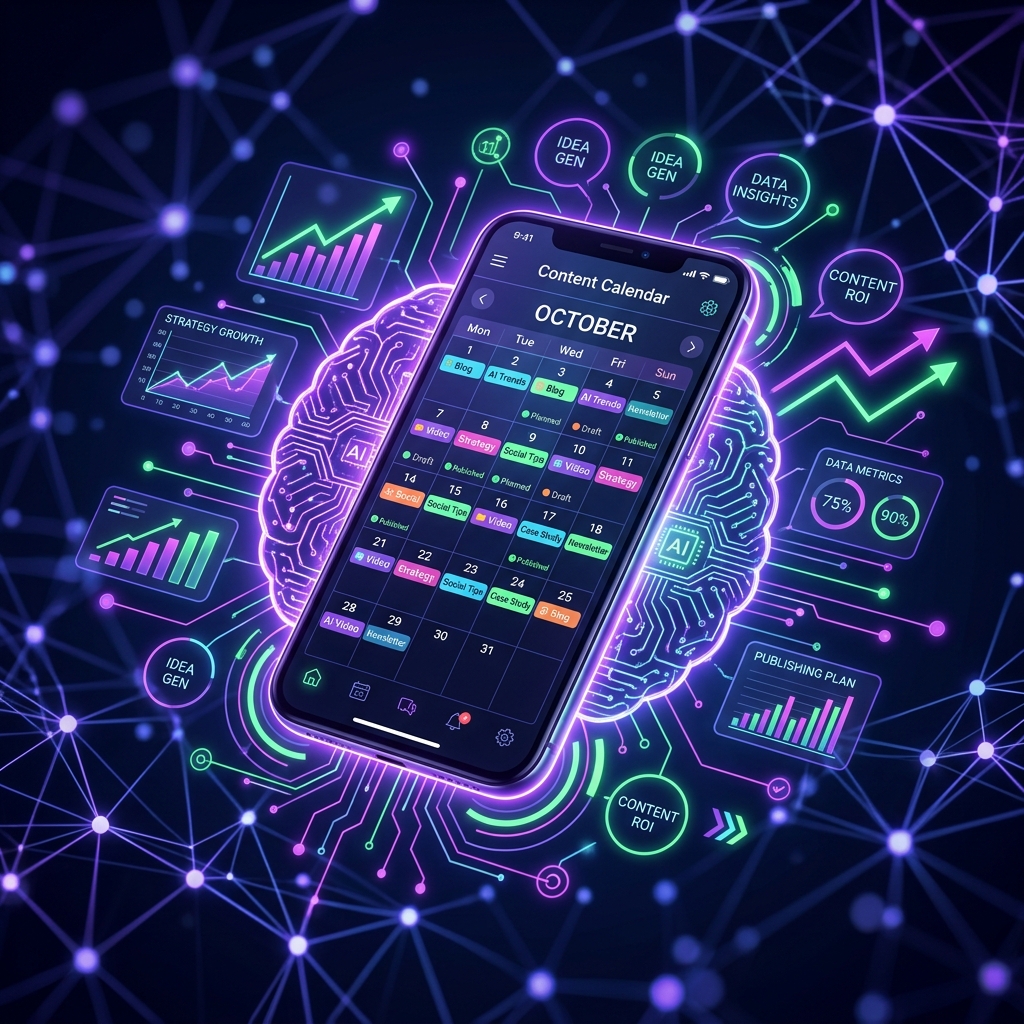
2. Content calendar architecture With a topic list in hand, ask the AI to organize those ideas into a publishing calendar — accounting for format variety, seasonal relevance, and audience journey stages (awareness, consideration, decision). This turns a chaotic idea dump into a strategic publishing schedule.
3. Hook and angle development The difference between a high-reach post and a forgettable one often comes down to the first line. AI is exceptionally good at generating multiple hook variations for the same piece of content, letting you pick the one with the most stopping power before you invest time in production.
4. Repurposing frameworks One piece of long-form content (a podcast episode, a blog post, a detailed tweet thread) can become five to ten pieces of Instagram content. AI accelerates this dramatically by extracting key points, generating slide structures, and suggesting format variations — all in seconds.
The Exact Prompts That Work
The quality of AI output is entirely dependent on the quality of your prompt. Here are frameworks that consistently produce useful results:
For topic ideation:
"I create content for [niche] targeting [specific audience type]. Their biggest frustrations are [list 3 pain points] and their goals include [list 3 outcomes]. Generate 25 Instagram carousel ideas that address these, focusing on [educational / inspirational / tactical] content. Format each as a specific working title, not a vague category."
For calendar planning:
"I publish [X times per week] on Instagram. My content formats are [carousels / Reels / Stories / mix]. Here are 20 topic ideas: [list]. Organize these into a 4-week publishing calendar, varying formats, and flag which topics are best for Reels versus carousels based on their visual potential."
For hook generation:
"Write 10 different opening hooks for an Instagram carousel about [topic]. Each hook should create curiosity, speak directly to [audience type], and be under 15 words. Make them conversational, not corporate."
For repurposing:
"Here's a blog post / podcast transcript: [paste content]. Extract the 5 most valuable insights and structure them as a 7-slide Instagram carousel outline. Include: slide 1 hook, slides 2–6 as individual insights with one-sentence explanations, slide 7 as a CTA. Keep language direct and accessible."
Building the Full System
The goal isn't to use AI once and declare victory. The goal is to build a repeatable workflow that compounds over time. Here's what that looks like in practice:
Weekly: Spend 20 minutes in a single AI session generating your content plan for the following week. Topics, hooks, format specs, posting schedule. Output goes into your content management system (Notion, Airtable, whatever you use).
Daily: Pull from your weekly plan. Use AI to draft the body of the content. Use Slidy Creator to convert carousel outlines into designed slides. Batch your posting for the week in a single session.
Monthly: Run an AI analysis of your previous month's performance. Paste in your top and bottom performers and ask the AI to identify patterns — which topics, formats, and hooks drove the most engagement — and recalibrate the following month's strategy accordingly.
Quarterly: Have the AI audit your overall content strategy against your current goals. Are you still speaking to the right audience? Has your niche evolved? What content categories have you been underproducing? A 30-minute quarterly review with AI as your strategic partner is worth more than most paid consultants.
The Tools That Make This Work
The AI layer handles strategy and ideation. But strategy without execution is just a document. The execution stack matters equally:
Content strategy & planning: Claude, ChatGPT, or Gemini for the strategic layer. Notion or Airtable for organizing the output into an actionable system.
Carousel production: Slidy Creator converts your AI-generated outlines into publish-ready carousel designs without the design time that kills content calendars. The combination of AI strategy and Slidy production is the fastest path from idea to polished post currently available.
Scheduling & analytics: Buffer, Metricool, or Later for scheduling. Your Instagram Insights for post-performance data to feed back into the AI strategy loop.
The creator who combines all three layers — AI strategy, efficient production tools, and data-informed iteration — is operating with a structural advantage over competitors who are still winging it session by session.
The Mindset Shift That Makes This Sustainable
The most common mistake creators make when adopting AI tools is expecting the AI to replace creative judgment. It won't — and it shouldn't. Your unique perspective, your specific audience relationship, your authentic voice: these are irreplaceable inputs that no AI can generate for you.
What AI replaces is the parts of content creation that shouldn't require your best thinking: blank-page anxiety, organizational overhead, format decisions, repurposing logistics. When you offload those to an AI system, you free your actual creative energy for the parts of content that only you can do.
That's not a shortcut. That's good resource allocation.
Start this week: run the topic ideation prompt above for your niche. Get 25 ideas. Pick your five favorites. Put them in your calendar. That's your content system — and you built it in 30 minutes.