
Niche Down or Stay Broad? The Branding Trap Nobody Warns You About
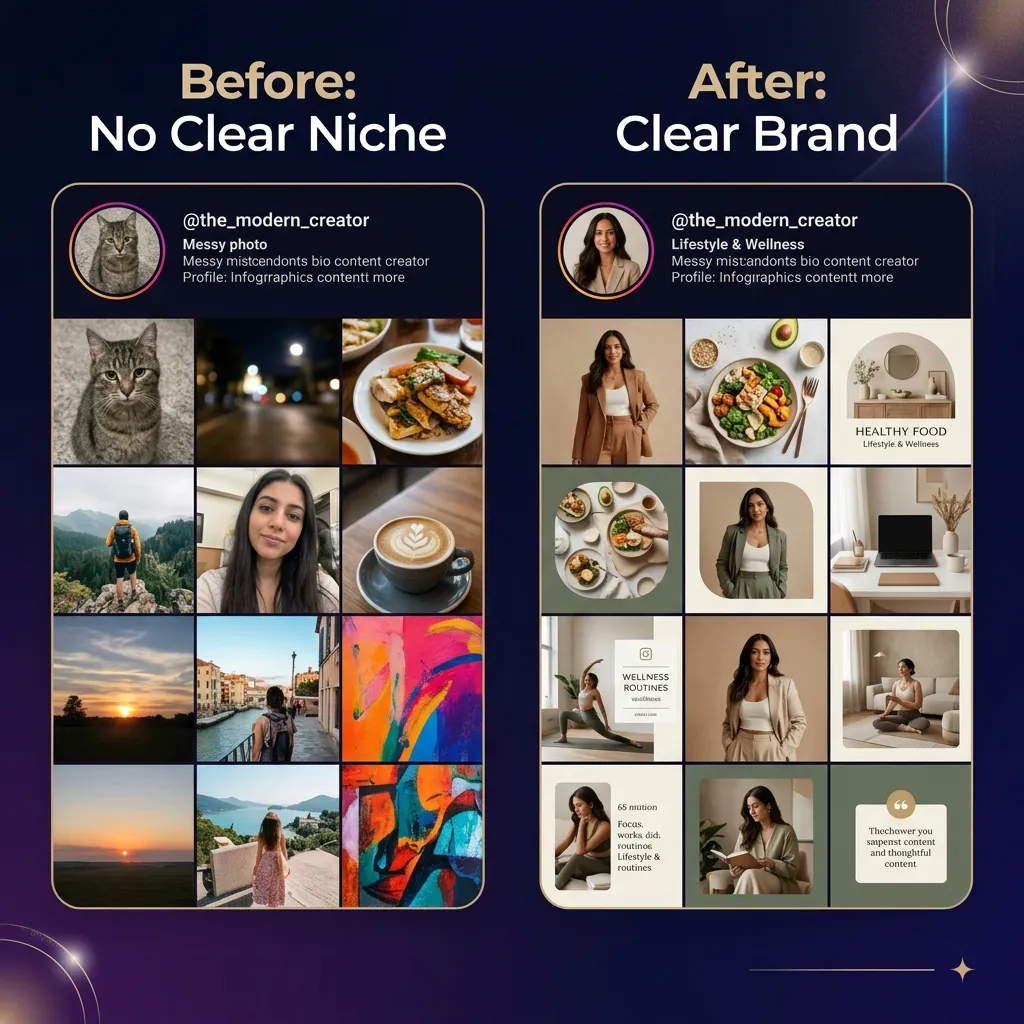
When I started on Instagram, I posted about everything. Productivity tips on Monday. Marketing on Tuesday. Book reviews on Wednesday. Random design inspiration on Thursday. A motivational quote on Friday.
My content was decent. But my growth was painfully slow — about 50 followers a month, sometimes less. And I couldn't figure out why. I was posting consistently, the quality was fine, engagement seemed normal. What was wrong?
Then a creator I respect told me something that stung: "People don't follow topics. They follow clarity. And right now, your page has no clear promise."
She was right. When someone landed on my profile, they couldn't figure out in 5 seconds what they'd get by following me. And if a visitor can't answer "what's in it for me?" in 5 seconds, they leave.
The Difference Between a Topic and a Transformation
This is the nuance that "niche down" advice usually misses. When people say "find your niche," most creators hear "pick a topic." So they choose "social media" or "fitness" or "productivity" — and their content stays broad even though they've technically "niched."
Your niche isn't a topic. It's a transformation.
"Social media tips" is a topic. "Helping solo creators go from 0 to 10K without ads" is a transformation. The second one is specific enough that the right people feel like you're speaking directly to them — and everyone else self-selects out (which is actually what you want).
More examples of the shift:
| Topic | Transformation |
|---|---|
| Fitness | "Helping busy parents get strong in 30 min/day, no gym needed" |
| Cooking | "Restaurant-quality meals in under 20 minutes with 5 ingredients" |
| Design | "Teaching non-designers to create scroll-stopping carousels" |
| Business | "Showing freelancers how to hit $10K months without working weekends" |
| Personal finance | "Building a $100K portfolio in your 20s on a normal salary" |
See the difference? The transformation version tells you exactly who it's for, what they'll achieve, and what constraint they're working within. That's a brand promise. That's what makes someone hit "follow."
The 90-Day Niche Test
If you're not sure what to niche into, here's the framework I used and have since recommended to dozens of creators:
Step 1: Pick your best guess. Choose the topic-plus-audience combination you're most excited about. It doesn't have to be perfect. You're testing, not committing for life.
Step 2: Commit for 90 days. Every single post for 90 days must fit this niche. No exceptions. No "but I really want to post about this other thing." Ninety days.
Step 3: Track three things. Follower growth rate, save rate per post, and DM quality. "DM quality" means: are strangers reaching out with genuine questions about your topic? If yes, you've found resonance.
Step 4: Evaluate. After 90 days, look at the data honestly. If growth accelerated, saves went up, and you're getting better DMs — you've found your niche. If not, pivot and test again. This isn't failure. It's market research.
Most creators never get past step 2 because they get bored or scared of limiting themselves. Push through. The compound effect of 90 days of focused content is dramatic.
Visual Branding: The Silent Part of Niching Down
Content niche is half the equation. The other half is visual consistency — and most creators ignore it.
When someone scrolls through your grid, they should see a pattern before they read a word. Consistent colors, consistent fonts, consistent layout structures. This doesn't mean every post looks identical. It means every post looks like it belongs together.
Pick 3–4 brand colors. A primary color, a secondary color, a background tone, and an accent. Use these across every carousel, Reel thumbnail, and Story highlight cover. Your colors should be different enough from mainstream Instagram aesthetics to stand out.
Choose 2 fonts maximum. One for headlines, one for body text. That's it. Switching fonts between posts makes your grid look random, even if the content is focused.
Develop 2–3 carousel templates. Not every post needs a unique layout. Having a few go-to templates that you rotate between actually strengthens brand recognition. Your audience starts recognizing your content mid-scroll, even before they see your name.
Your Bio Is a Landing Page
Your Instagram bio gets maybe 3 seconds of attention from a new visitor. Every word has to work.
Line 1: Who you help. "For solo creators who want to grow without burning out." Specific. Clear. Instantly filters the right audience.
Line 2: What you deliver. "Daily tips on content systems, carousels, and engagement." Now they know what kind of content to expect.
Line 3: Credibility or social proof. "Grew from 0 to 50K in 14 months" or "Featured in Later, Buffer, and Hootsuite." Something that makes them think "this person knows what they're talking about."
CTA + Link: "Free carousel template ↓" with a link. Give them a reason to tap.
Remove everything else. Your bio isn't a résumé or a list of hobbies. It's a 3-second pitch.
When It's OK to Expand
Here's the part the "niche down forever" crowd won't tell you: at some point, you should broaden.
Once you've built a strong core audience — typically 10K+ followers who are genuinely engaged — you've earned the right to expand into adjacent topics. Your audience trusts you. They'll follow you into new territory because they know you deliver value.
But expansion should be strategic, not random:
Expand into adjacent transformations. If your niche is "Instagram growth for solo creators," you can expand into productivity for creators, then tools for creators, then building a creator business. Each step is adjacent and natural.
Test with 1 post per week in the new area. Keep your core content dominant. See how the new topic performs. If saves and engagement hold up, gradually increase.
Never abandon your core. The fastest way to lose an audience is to pivot completely into a new topic. Your original niche is what built the trust. Keep at least 50% of your content there, even as you expand.
The Honest Part
Niching down isn't exciting. It feels limiting. You'll watch other creators post about whatever they want and wonder if you made the wrong choice. You'll have ideas that don't fit your niche and feel frustrated that you can't use them.
Push through that discomfort. The creators who grow the fastest are the ones who are willing to be boring for 90 days while they build something that compounds. Clarity isn't a cage — it's a compass.
Your brand isn't your logo. It's the promise people feel when they see your name in their feed. Get specific. Get clear. The growth follows.