
The Content Batching System That Gave Me My Weekends Back
For eight months, I created content the night before posting. Every single day. Scrambling for ideas at 11 PM, editing at midnight, posting half-asleep at 7 AM. I thought being "consistent" meant being constantly busy.
It didn't. It meant I was constantly exhausted, and my content looked exactly like what it was — rushed work produced under pressure by someone who was running out of ideas three months ago.
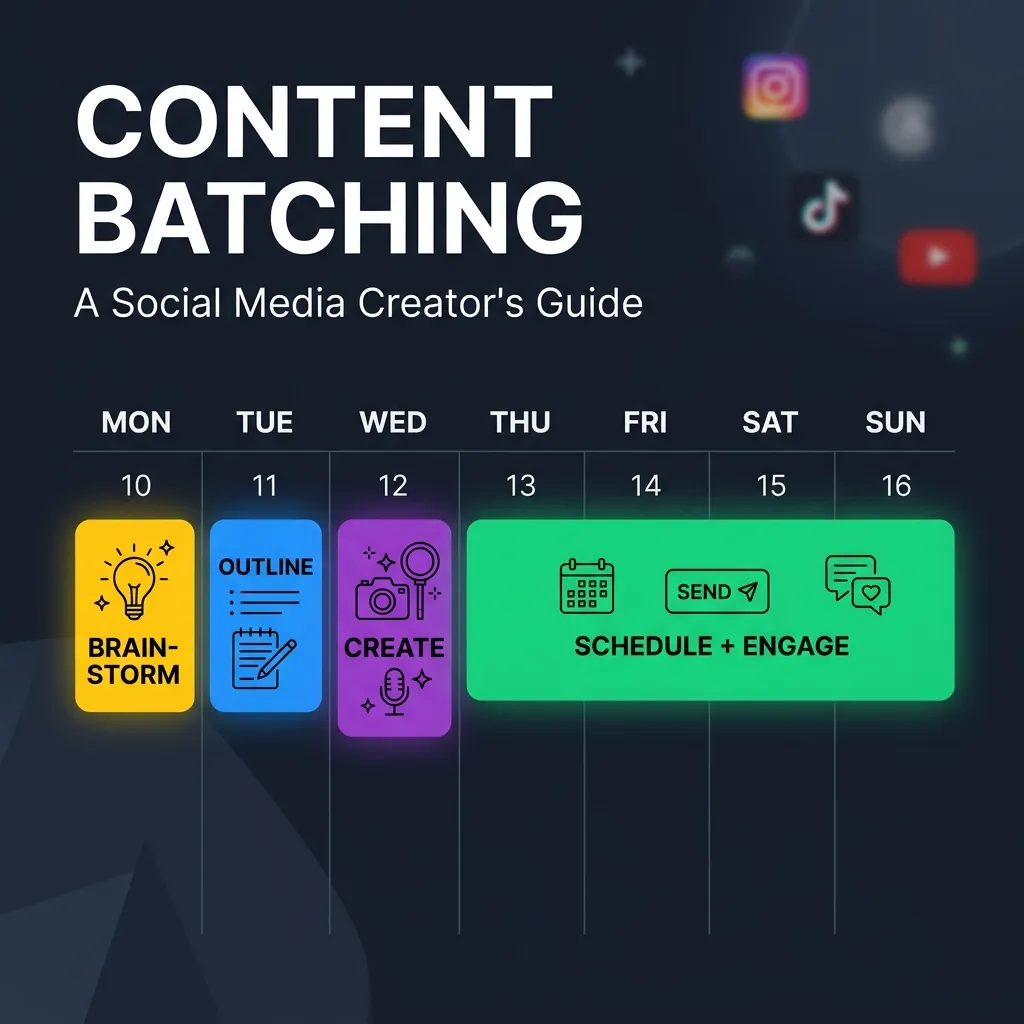
Then I switched to batching. Not just "batch creating" in a vague sense, but an actual structured system with specific days for specific tasks. Within three weeks, my content time dropped from roughly 14 hours per week to about 5. My posts got better. And I got my weekends back.
Here's the exact framework.
Monday: The Brain Dump (30 Minutes)
I open a notes app and set a timer for 20 minutes. Then I write every content idea I can think of. No filtering, no judging, no worrying about whether it's good. Just volume.
Some prompts I use to get started:
- What questions did I get in DMs this week?
- What frustrated me about my own workflow recently?
- What did I see another creator do that I disagreed with?
- What's something I learned this month that I wish I'd known sooner?
- What's a mistake I made early on that I've since fixed?
I usually get 15–25 raw ideas. Most of them are rough — sometimes just a phrase or a question. That's fine. The goal isn't polished concepts. It's raw material.
The remaining 10 minutes I spend tagging each idea with a content pillar. I have three: growth tactics, content creation process, and personal stories. Every idea has to fit one of these. If it doesn't, it gets cut. This keeps my feed focused even when my brain isn't.
Tuesday: Filter and Outline (60 Minutes)
I go through Monday's brain dump and pick the 7 strongest ideas. "Strongest" means: I can explain it in one sentence, I have a personal angle or concrete example, and I'd actually want to read a post about it.
For each of the 7, I write a loose outline:
- Hook: What's the first line or first slide? What makes someone stop?
- Core lesson: What's the one thing someone should walk away knowing?
- Structure: Is this a listicle, a story, a framework, a comparison?
- CTA: What do I want people to do — save, comment, share, follow?
This step is where most of the creative thinking happens. By the time I'm done, I have 7 posts that are maybe 60% done — even though I haven't opened a design tool or picked up a camera yet.
Wednesday: Production Day (3 Hours, Protected)
This is the heavy day. I block 3 uninterrupted hours — no calls, no DMs, no email. I put my phone in another room. And I produce everything.
Carousels: I work through the outlines for my carousel posts, writing the slide-by-slide copy and designing the slides. This used to take me 90 minutes per carousel. Since I started using Slidy Creator, I can get a carousel from outline to export in about 15 minutes. I paste in my outline, choose a visual style, tweak the copy, and export. That single change saved me more time than any other tool I've tried.
Reels: I film all Reels back-to-back. Same setup, same lighting, same background. I change shirts between takes so it doesn't look like I filmed everything at once (although honestly, most viewers don't notice or care). I edit using jump cuts to keep the energy tight.
Captions: I write all captions while the carousel designs are fresh in my mind. This is faster than coming back to write captions later because the context is already loaded.
By the end of Wednesday, I have 7 ready-to-post pieces of content.
Thursday–Sunday: Schedule, Engage, Rest
From Thursday onward, I don't create anything new. I schedule posts using a scheduling tool (I use Later, but the specific tool doesn't matter). I engage with my audience — responding to comments, replying to DMs, commenting on other creators' posts.
And here's the part that changed my relationship with content: I rest. I go outside. I read a book. I have conversations that have nothing to do with social media. This isn't just self-care — it's strategic. The ideas I come up with during Monday's brain dump are exponentially better when I've spent the weekend actually living instead of staring at analytics.
How to Start Batching If You've Never Done It
If you're currently creating content daily, switching to batching cold turkey feels terrifying. Here's how to ease in:
Week 1: Keep your daily routine, but also batch 3 posts on Wednesday. Post those alongside your daily content the following week.
Week 2: Drop to 5 posts per week. Use your batched content to fill the gaps. Notice how much mental space opens up.
Week 3: Go fully batched. Monday brainstorm, Tuesday outline, Wednesday produce, Thursday–Sunday schedule and engage.
Week 4: Evaluate. Was your content quality better or worse? Was your engagement up or down? I'd bet money it improved — because batched content is created with intention instead of desperation.
Common Batching Mistakes
Mistake 1: Batching without outlining first. If you sit down on production day with a blank page and no outlines, you'll spend the first hour doing what should have been done on Tuesday. The outline step is what makes production day fast.
Mistake 2: Not protecting production time. If your 3-hour block keeps getting interrupted by meetings, DMs, or "quick favors," batching will feel just as stressful as daily creating. Block the time. Guard it.
Mistake 3: Creating 14 posts instead of 7. Batching isn't about producing more content. It's about producing the same amount of content more efficiently. If you batch 14 posts per week, you'll burn out faster than you did before.
Mistake 4: Never reviewing what worked. At the end of each week, I spend 10 minutes checking which posts performed best. That informs next Monday's brain dump. Without this feedback loop, you're batching blindly.
The Mindset Shift
The real transformation isn't about the schedule. It's about separating creation from distribution.
When you create and distribute on the same day, both suffer. You're context-switching between "think of an idea," "design the visuals," "write the caption," "pick a hashtag," and "respond to comments" — all within the same hour. Your brain can't do deep creative work and shallow administrative work at the same time.
Batching lets you do deep work on Wednesday and shallow work the rest of the week. Each mode gets your full attention. The content gets better. The engagement gets better. And you stop dreading the daily content hamster wheel.
You don't need to post more. You need to create smarter. And smarter starts with a system.