
"Just Post More" Is the Worst Advice on Instagram Right Now
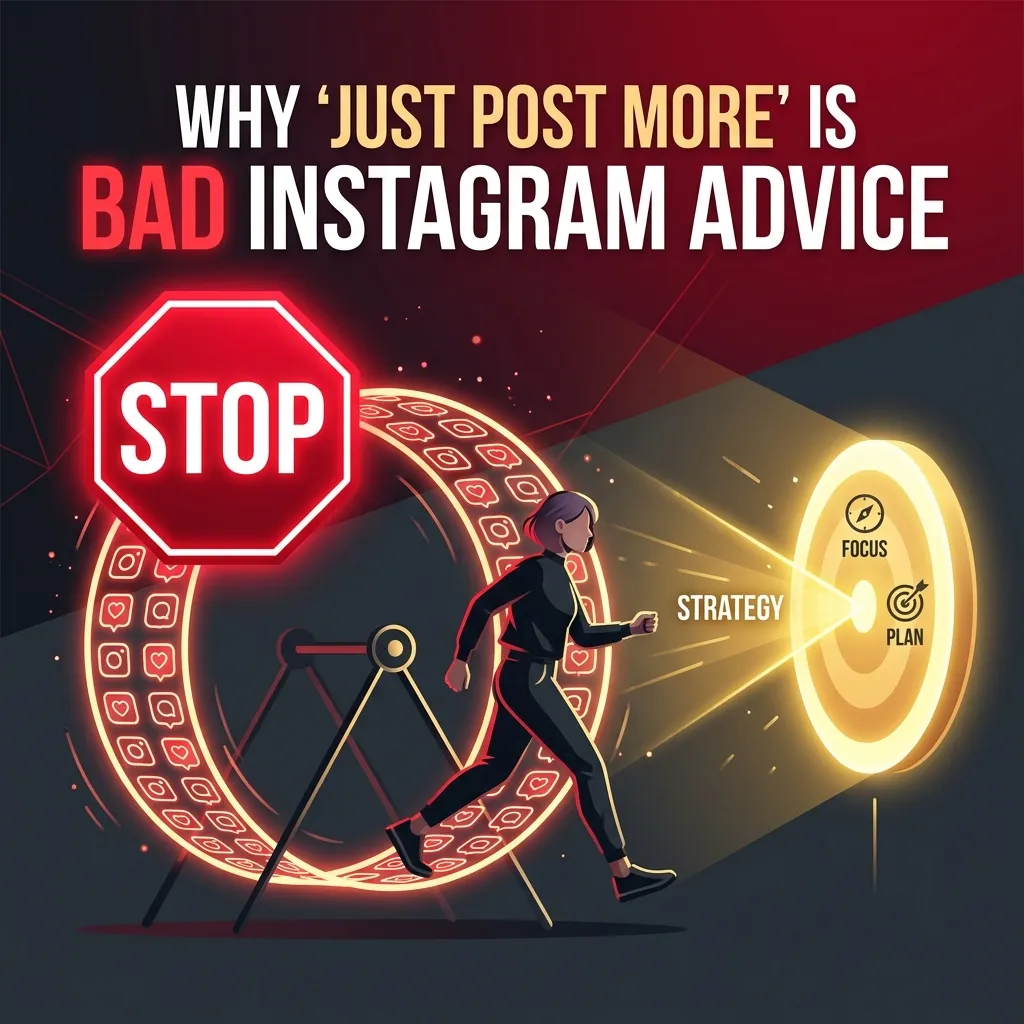
Every time someone asks how to grow on Instagram, someone in the comments drops the magic answer: "Just post more. Be consistent. Post every day."
And look — consistency matters. Showing up regularly builds audience expectations and gives the algorithm a predictable signal. But "post more" as a growth strategy is like telling someone to "just work harder" when their business model is broken. The effort isn't the problem. The direction is.
I know this because I lived it.
The 5-Month Daily Posting Experiment
From January to May last year, I posted every single day. Seven days a week. 153 posts total. I was religious about it — never missed a day, even when I was sick, traveling, or completely tapped out of ideas.
I gained 400 followers.
Not 400 per month. 400 total. Over five months. Roughly 2.6 followers per day, which felt like throwing content into a void.
And here's the worst part: I was working 2–3 hours per day on content. That's over 450 hours invested for a result I could have gotten by doing literally anything else. The burnout was real. I started resenting Instagram, resenting my audience, and resenting the whole concept of "content creation."
What Changed When I Cut Back
I was ready to quit. But before I did, I tried one last experiment: I cut back to 4 posts per week. But I changed my approach fundamentally.
Instead of asking "what should I post today?" I asked "what does my audience need this week?"
Instead of filling a calendar, I built a system with three content types, each serving a specific purpose.
Instead of measuring effort in posts per week, I started measuring impact per post.
In the next three months — posting LESS — I gained 3,000 followers. Same niche, same account, same face. The only thing that changed was how I thought about each piece of content.
The Three Content Types Framework
This is the framework that replaced daily posting. Every week, I create exactly 4 posts, and each one fits one of three categories:
Type 1: Reach Content (1 post/week)
One Reel specifically designed to find new people. Broad hook, trending format if applicable, under 30 seconds. This is the only content where I care about views and non-follower reach.
The goal of reach content is acquisition — bringing new people to my profile. I'm not trying to teach them everything in one Reel. I'm trying to make them curious enough to visit my page and follow.
Example: A 20-second Reel with the hook "The posting strategy that's actually killing your growth" with a quick, punchy explanation. Broad enough for anyone in my niche to relate to.
Type 2: Depth Content (2 posts/week)
Two carousels that teach something specific. These aren't for new followers — they're for the people who already follow me and need a reason to stay. Save rate is the primary metric here, not reach.
Depth content builds trust. It demonstrates expertise. It's the content that makes someone think "I'm glad I follow this person." Without it, your new followers from reach content have no reason to stick around.
Example: A 10-slide carousel breaking down "My exact content batching system — Monday through Friday" with actionable detail on every slide.
Type 3: Connection Content (1 post/week)
One personal or behind-the-scenes piece — could be a Story series, a personal caption, a Q&A, or a vulnerability post. This content converts followers into fans by showing the person behind the content.
Connection content has no performance metric. It's not about reach or saves. It's about DMs, replies, and the feeling of being in a real community rather than a content library.
Example: A Story series showing my actual content creation process, including the messy parts — bad first takes, rejected carousel designs, the frustration of a post that underperformed.
How to Measure Impact Per Post
If you're not measuring posts by week anymore, how do you know what's working? Here are the four metrics I track for every post:
Save rate (saves ÷ impressions). Target: above 2% for carousels. This tells you whether your content has lasting value.
Non-follower reach percentage. Target: above 30% for reach content. This tells you whether your content is discoverable.
Comment-to-impression ratio. Target: above 1%. This tells you whether your content sparks conversation.
Profile visits from post. This tells you whether new people are curious enough about you to check your page. If a Reel gets 50K views but only 20 profile visits, the content was entertaining but not compelling enough to drive curiosity.
Track these for 30 days. You'll quickly see which of your posts drive real results and which were just filling space.
The Content Audit: Cleaning Up What's Not Working
When I shifted from daily to 4x/week, I also audited my existing content. This was uncomfortable but revealing.
I went through my last 50 posts and categorized each one: reach, depth, or connection. What I found:
- 38 out of 50 were "depth" content — but without strong hooks, so they reached almost nobody.
- 8 were attempting to be reach content but were too niche for new audiences.
- 4 were connection content, and those were my highest-engaged posts by far.
I was creating almost exclusively one type of content and neglecting the other two. No wonder my growth was flat — I had no acquisition engine and no community-building engine. Just a content library nobody could find.
What "Strategic Consistency" Actually Looks Like
The gurus aren't wrong that consistency matters. But they're confusing frequency with consistency.
Frequency is how often you post. 7 times a week, 4 times a week, 3 times a week.
Consistency is how predictable your value delivery is. Do your followers know what to expect from you? Do they know when to expect it? Does every post serve a clear purpose?
You can post once a week and be incredibly consistent if that one post always delivers genuine value. You can post three times a day and be wildly inconsistent if the quality fluctuates and the topics are random.
Here's what strategic consistency looks like in practice:
- Same days, same times. I post on Monday, Wednesday, Thursday, and Saturday at 8 AM. My audience expects it. The algorithm expects it.
- Same content pillars. Every post fits one of three pillars. I never post something that doesn't belong.
- Same quality floor. No post goes live unless I'd save it myself. If I wouldn't bookmark my own content, why would a stranger?
The Permission to Post Less
The hardest part of this shift wasn't strategic. It was emotional.
I felt guilty posting less. Every creator I admired seemed to be posting daily. Every growth tip I'd ever read emphasized volume. "The algorithm rewards consistency." "You need to be omnipresent." "If you're not posting, you're losing."
All of that is partially true — and dangerously misleading. The algorithm rewards engagement, not volume. You need to be memorable, not omnipresent. If you're posting content nobody engages with, you're losing visibility faster than if you weren't posting at all.
Give yourself permission to post less. Then use the time you saved to make each post genuinely matter.
Stop measuring your effort in posts per week. Start measuring it in impact per post. The difference will shock you.