
Build a Content Flywheel, Not a Content Treadmill
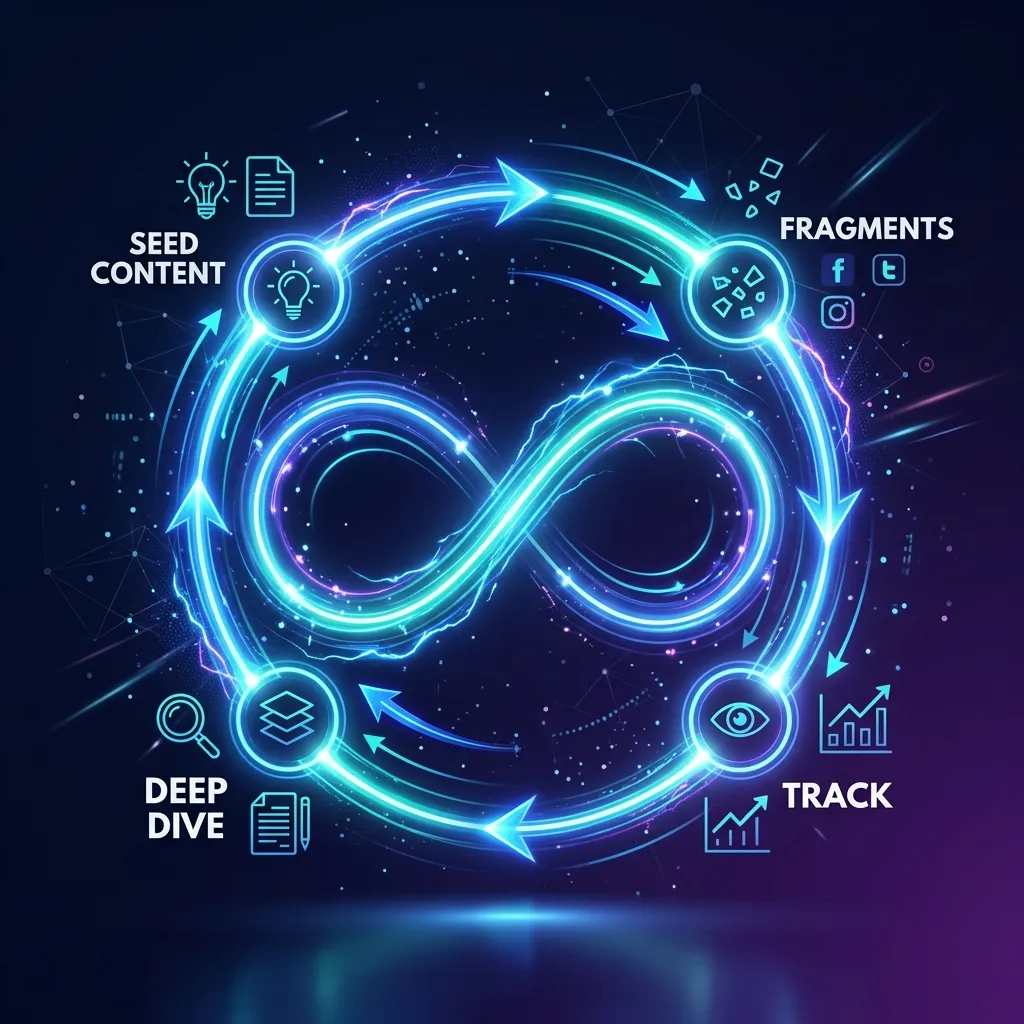
Most creators are on a treadmill. They create a post, publish it, and move on. Tomorrow, they start from zero again. A blank page. A new idea from scratch. No momentum. No compound effect. Just the daily grind of inventing content from nothing, over and over.
A flywheel is fundamentally different. It's a system where each piece of content feeds the next one. The output of Monday's post becomes the input for Wednesday's. Your best ideas get deeper. Your weakest ideas get pruned. And the whole system gets smarter over time because your audience is literally telling you what they want more of.
I spent 14 months on the treadmill before I figured this out. Here's the system that replaced it.
The Four Steps of a Content Flywheel
Step 1: Create One Long-Form Piece
Every cycle starts with one substantial piece of content. A 10-slide carousel, a 60-second Reel with real depth, or a detailed caption post. Something that takes a clear position and delivers meaningful value.
This is your "seed" content. It needs to be strong enough to generate fragments — which means it needs a clear core insight, not just surface-level tips. "5 random Instagram tips" can't seed a flywheel. "Why your first slide matters more than your other nine combined" can.
Example: A carousel titled "The 3 Content Types Every Creator Needs (And How to Balance Them)" — 10 slides breaking down reach content, depth content, and connection content with examples of each.
Step 2: Repurpose Into Fragments
That one carousel now becomes 4–5 additional pieces of content:
- A Reel summarizing the single most interesting point from the carousel in 20 seconds. Different audience, different format, same core insight.
- A Story series asking your audience which content type they use most. This drives engagement and gives you data for step 3.
- A tweet-style caption post pulling the best one-liner from the carousel. Just the sentence, on a clean background. Minimal effort, often high engagement.
- A save-worthy infographic restructuring the framework as a visual checklist or flowchart.
Each fragment reaches people who might have missed the original. Different formats reach different segments of your audience. And each one takes 10–15 minutes to create because the thinking is already done — you're just repackaging.
Step 3: Track What Resonates
This is where the flywheel becomes intelligent. After your fragments are out, look at the numbers:
- Which fragment got the most saves? (Indicates lasting value)
- Which got the most shares? (Indicates share-worthy framing)
- Which got the most comments? (Indicates emotional or controversial resonance)
- Which got the most non-follower reach? (Indicates discovery potential)
Your audience is voting with their engagement. The fragments that perform best reveal what your audience wants more of.
Step 4: Go Deeper on Winners
Take the fragment that won and create a new long-form piece that explores that specific angle in more depth.
If the Reel about "reach content" outperformed all other fragments, your next seed carousel should go deeper on reach content: "The Reach Content Playbook: How to Get Non-Followers to Find You on Instagram." That becomes the next cycle's seed. And the flywheel turns again.
The Compound Effect: What Happens Over 3–6 Months
In the first month, the flywheel feels like extra work. You're creating fragments, tracking metrics, analyzing data. It seems like more effort than just posting new content.
By month two, you notice something: your ideas are getting sharper. You're not guessing what to post anymore. Your audience's engagement data is telling you exactly what resonates, and you're following the signal instead of your assumptions.
By month three, you stop running out of ideas entirely. Every winning fragment spawns two or three new seed ideas. Your content calendar fills itself. The "what do I post today?" panic disappears.
By month six, the quality gap between your content and your competitors' is visible. While they're still creating from scratch every day, you're iterating on proven winners. Your best ideas have been refined through three or four cycles. The depth shows.
This is the compound effect that no amount of daily content creation can replicate. You can't brute-force your way to better content. But you can iterate your way there — and the flywheel is the iteration engine.
Tools for Each Flywheel Step
You don't need expensive tools to run a flywheel. Here's a minimal stack:
For Step 1 (creating seed content): Slidy Creator for carousels, or a basic camera for Reels. The content creation tool matters less than the quality of the idea.
For Step 2 (repurposing): Slidy Creator again for carousel-to-infographic or carousel-to-different-format conversions. Descript for pulling clips from longer videos. Canva for simple graphics.
For Step 3 (tracking): Instagram Insights is sufficient. You don't need a fancy analytics dashboard. Write down four numbers for each fragment: saves, shares, comments, non-follower reach. A simple spreadsheet works.
For Step 4 (going deeper): Your brain. This step is pure strategy. Look at what won, ask "why did this resonate?" and explore that direction. No tool can do this for you.
Common Flywheel Mistakes
Mistake 1: Repurposing without adapting. Copy-pasting your carousel text into a Reel script doesn't work. Each format has different constraints and expectations. Repurposing means translating the core idea into a format-native execution.
Mistake 2: Ignoring the data. If you skip step 3, you're not running a flywheel — you're just creating more content. The data is what makes the flywheel intelligent. Without it, you're guessing.
Mistake 3: Going deeper on the wrong winner. A fragment might perform well because of the hook, not the topic. Before creating a deeper version, ask: "Did this perform because the audience wants more on this topic, or because the format/hook was strong?" If it's the latter, apply that hook style to your next seed content on a different topic.
Mistake 4: Never starting because the system feels complex. Start with just step 1 and step 2 next week. Create one carousel and make two fragments from it. That's it. Add steps 3 and 4 the following week. The system doesn't need to be perfect on day one.
Mistake 5: Repurposing old content that wasn't good in the first place. The flywheel amplifies quality. If the seed content is weak, the fragments will be weak, and the data will be meaningless. Start with your best ideas.
Treadmill vs. Flywheel: A Summary
| Treadmill | Flywheel | |
|---|---|---|
| Starting point | Blank page every day | Last week's winner |
| Idea generation | Stressful, from scratch | Data-driven, iterative |
| Content quality | Inconsistent | Compounds over time |
| Burnout risk | High | Low (you work smarter) |
| Audience understanding | Assumed | Measured |
| Time per post | Same forever | Decreases over time |
The creators who grow the fastest aren't necessarily more creative. They're more systematic. They've figured out how to let their best content do double, triple, and quadruple duty — while the rest of us start from scratch every morning.
Stop creating in a vacuum. Build the loop.