
12 Reels Hooks That Actually Stop the Scroll (Tested and Proven)
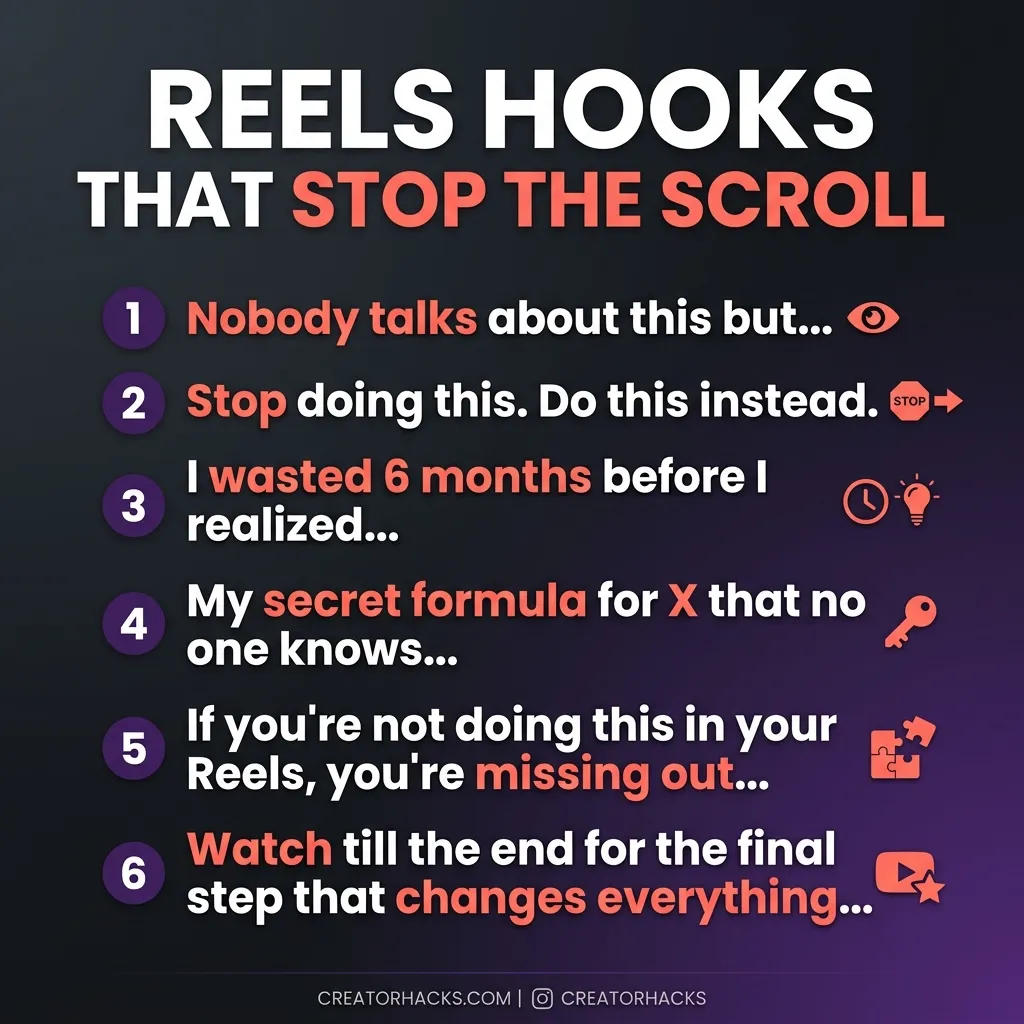
I keep a swipe file of Reels hooks that made ME stop scrolling. Not as a creator analyzing content — as a person mindlessly scrolling at midnight, half-watching a show, barely paying attention. Those are the hooks that actually work. Because that's the state your audience is in when they encounter your Reel.
Over the past year, I've collected over 200 hooks in my swipe file. I've tested the best ones on my own content and tracked which consistently perform. Here are the 12 that get strong watch-through rates across different niches — along with why they work psychologically and how to use them without the content falling flat.
The 12 Hooks
Hook 1: "Nobody talks about this, but…"
Why it works: It implies insider knowledge. The viewer thinks: "If nobody talks about it, maybe I don't know about it either." That's a curiosity gap.
Example in practice: "Nobody talks about this, but the first 30 minutes after you post matter more than the content itself." Follow with a specific explanation of first-hour engagement strategy.
The trap to avoid: The "thing nobody talks about" must actually be non-obvious. If you follow this hook with basic advice, you'll lose trust instantly.
Hook 2: "I wasted 6 months doing [X] before I realized…"
Why it works: It triggers loss aversion. The viewer thinks: "Am I wasting my time doing that too?" They need to watch to find out.
Example: "I wasted 6 months designing carousels in Canva before I realized there was a faster way." Then show the workflow shift and results.
Hook 3: "Here's why your [strategy] isn't working."
Why it works: Direct address + implied problem. If the viewer uses that strategy, they can't scroll past without knowing what's wrong with it.
Example: "Here's why your hashtag strategy isn't working anymore." Then explain the shift from hashtag-driven to content-quality-driven distribution.
Hook 4: "The difference between creators at 1K and 100K is…"
Why it works: It implies a gap that's bridgeable. Viewers at 1K want to know the difference so they can close it. Viewers at 100K want validation that they're doing the right thing.
Example: "The difference between creators at 1K and 100K? The 100K creators post less and plan more." Then break down the strategic difference.
Hook 5: "Stop doing [common thing]. Do this instead."
Why it works: It disrupts an existing behavior. If the viewer does the "common thing," they need to know why it's wrong and what to do instead.
Example: "Stop posting your Reels without a text overlay on the first frame. Do this instead." Then show the impact of text overlays on retention.
Hook 6: "I studied 50 [things] and found one pattern."
Why it works: Research implies authority. "One pattern" implies simplicity. The combination is irresistible: credible expertise distilled into a single insight.
Example: "I studied 50 viral carousels and found one pattern: they all had fewer than 15 words per slide." Then explain why visual simplicity drives performance.
Hook 7: "This one change doubled my [metric]."
Why it works: Specificity ("one change," "doubled") makes it feel actionable and achievable. The viewer thinks: "If one change can double their results, I need to know what it is."
Example: "This one change doubled my save rate overnight: I started ending every carousel with a checklist slide instead of a 'follow for more' slide."
Hook 8: "Hot take: [controversial opinion about your niche]."
Why it works: Controversy creates emotional investment. The viewer watches either to agree passionately or to formulate their counterargument. Either way, they watch through — and often comment.
Example: "Hot take: posting daily is actively hurting most small creators." Then explain why quality-over-quantity works better at small scale.
Hook 9: "If I had to start from zero, here's what I'd do first."
Why it works: It captures two audiences simultaneously. Beginners want the roadmap. Experienced creators want to compare their approach. The hypothetical framing makes it feel strategic rather than preachy.
Example: "If I had to grow a new Instagram account from zero, the first thing I'd do is post 3 carousels a week for 90 days — nothing else." Then explain why.
Hook 10: "The mistake I see every [niche] creator making."
Why it works: Nobody wants to be the one making the mistake and not knowing it. This hook triggers a self-check reflex: "Is this about me?"
Example: "The mistake I see every fitness creator making: spending 30 minutes on a workout and 5 minutes on the content about it."
Hook 11: "You don't need [thing everyone thinks you need]."
Why it works: It challenges a widely held assumption. If the viewer has been stressing about the "thing," this is immediately liberating — and they need to hear the reasoning.
Example: "You don't need 10K followers to make money from content. Here's what you actually need." Then outline the minimum viable audience concept.
Hook 12: "Watch this before you [common action in your niche]."
Why it works: Urgency plus implied risk. The viewer was going to do the thing anyway — now they feel they should watch first. It positions your content as essential context for a decision they're about to make.
Example: "Watch this before you buy a ring light." Then explain why natural lighting and positioning matter more than equipment.
Delivering on the Promise
The hook gets people to stop. What keeps them — and determines whether they follow or share — is whether the content delivers on the hook's promise.
"Nobody talks about this" followed by common advice will get you unfollows, not followers. The hook creates an expectation. The content must exceed it.
Rule of thumb: If your hook promises a specific insight, the insight should be genuinely non-obvious. If your hook implies a personal story, tell the actual story. If your hook claims data, show the data. Under-promise with the hook and over-deliver with the content — even slightly.
Combining Hooks With Visual Techniques
A verbal hook is only half the equation. The visual first frame amplifies the hook or undermines it.
Text overlay: Put the hook as bold text on the first frame. This catches mute-scrollers (which is a huge percentage of viewers) and gives the hook two entry points: audio and visual.
Physical movement: Start the Reel with action — walking toward the camera, picking up an object, turning around. Static first frames are easy to scroll past. Movement triggers a "something is happening" response.
Pattern break: Start with an unexpected visual — a screenshot, a reaction face, an unexpected setting. Anything that doesn't look like the 50 other Reels above and below yours in the feed.
Building Your Personal Hook Swipe File
Consuming content passively is research, but only if you capture what works.
Step 1: Every time a Reel stops YOUR scroll, screenshot it. Don't analyze in the moment — just capture.
Step 2: Once a week, review your screenshots. For each one, write down: what was the hook? Why did it stop you? What emotion did it trigger?
Step 3: After a month, look for patterns. You'll find 3–4 hook types that consistently work on you — and those are the ones that will feel most natural when you create your own.
Step 4: Adapt your top hooks to your own niche and voice. Don't copy word-for-word. Understand the structure and fill it with your own content.
Your swipe file is the most valuable creative asset you'll ever build. It turns "I don't know what to post" into "which of these 50 proven hooks do I want to use today?"
Your content is only as good as its first second. Make it count.